

A recent analysis of US labor data reveals a concerning trend: young male college graduates are now experiencing unemployment rates comparable to their non-college-educated peers. This shift, captured in a graph based on the US Current Population Survey and published by the Financial Times, underscores a significant change in the job market dynamics for young adults aged 22 to 27.
The graph illustrates the seasonally adjusted, three-month rolling average of unemployment rates among young men and women from 2008 to 2025, broken down by education level: college graduates versus non-college graduates.
For Men:Historically, non-college men have faced significantly higher unemployment rates than their college-educated counterparts, often by a margin of 5–10 percentage points.
• However, since around 2023, the unemployment rate for male college grads has risen to nearly equal that of non-college men, both hovering around 7–8% in 2025.
• This convergence marks a dramatic shift in the perceived value of a college degree in securing employment for young men.
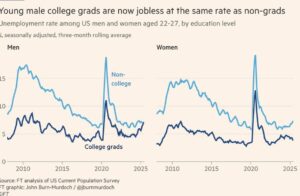
For Women:The gap between college-educated and non-college-educated women has remained more stable.
• Non-college women continue to face higher unemployment rates than college grads, though the gap is narrower than in previous years.
• Unlike the male cohort, college-educated women still enjoy a consistent advantage in job security.
The COVID-19 Spike: Both male and female groups experienced a sharp unemployment spike in 2020 due to the COVID-19 pandemic. The spike was steeper for non-college individuals, reflecting their greater vulnerability to economic shocks. Still, college graduates also saw a notable rise, particularly among men, suggesting that even higher education could not fully shield young workers during crisis periods.
Why Is This Happening? Several factors may be contributing to the recent parity in male unemployment rates:
• Shifting labor market demands:Many traditionally male-dominated fields that once required degrees are automating or shrinking, while non-college sectors (like trades) are gaining momentum.
• Underemployment and degree inflation:Many young men with degrees are working in jobs that do not require them, blurring the benefits of higher education.
• Gender dynamics in education and hiring:Women are outpacing men in college enrollment and graduation, possibly leading to stronger employment outcomes for young women.
• Economic transitions: Industries with high male participation—such as manufacturing or certain tech roles—have become volatile, with some experiencing contraction or offshoring
.Implications This trend challenges long-held assumptions about the universal value of a college degree, especially for men. It also raises questions about the adaptability of the higher education system to changing labor market realities. If this pattern continues, it could fuel skepticism about the return on investment in college education and potentially shift societal views on alternative career paths, such as vocational training or entrepreneurship.
ConclusionThe data reveals a troubling reality: young male college graduates are no longer guaranteed better employment prospects than those without degrees. While the story differs for women—who still benefit from a degree in the labor market—the narrowing gap for men highlights broader structural changes that require both policymakers and educators to rethink how young people are prepared for the workforce.