

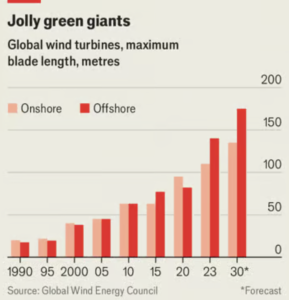
The blades of wind turbines are getting bigger and bigger. Two decades ago a 40 meter blade was an achievement but nowadays, the state of art is triple that. The turbine’s output is proportional to the square of blade length, this means wind turbines with longer blades have higher outputs. The biggest turbines in 2004 could generate about two megawatts. Today’s giant turbines can exceed 15 megawatts.
However transporting these giant blades is a problem. Offshore turbines are currently equipped with longer blades. The main reason is that the transportation of blades is easier. The blades are loaded into ships and they move towards the find farms. However, the cost of offshore wind turbines are much higher than onshore turbines.
For onshore farms, transporting the blades is the main problem. Many solutions have been suggested, currently in many developed countries there are softwares with a digital model of transport corridors. With precision of centimeters, the softwares can assess whether a blade can pass from a corridor or not? However, even if it is possible, it can take months for a travel permit.
Two promising solutions are 3D printing technology and airships. 3D printing would let the blades be manufactured at the site so there would be any need to carry blades for large distances. However, the printing technology is lagging behind the wind turbine blade manufacturing. Currently the maximum length of 3D printed turbines is around 40 meters, more advanced 3D printing technology is needed.
The other solution is to carry the blades via airships. This is actually a more practical approach and many analysts believe that the demand for carrying blades will resuscitate airship manufacturing after more than a hundred years.
Source: Economist