
Citizens’ morale suffers as a result of corruption. Well-functioning societies rely on moral citizens who do the right thing even when no one is looking. Seeing other people, particularly politicians, break the rules, on the other hand, discourages them from upholding ethical values.
In a paper titled “Contagious Dishonesty: Corruption Scandals and Supermarket Theft,” Giorgio Gulino and Federico Masera demonstrated this effect quantitatively in the American Economic Association journal.
They used the auditing results of nearly 300,000 self-service supermarket checkouts in Italy. Customers scan their own products while shopping in these supermarkets. This method allows them to shoplift by scanning low-priced items but taking more expensive items.
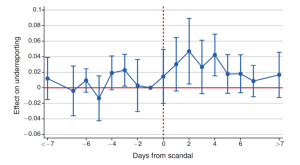
The authors identify the days when news of public officials’ corruption spread widely throughout society. The results are insightful, as evidenced by this graph. On the X axis, 0 represents the date when the corruption was made public. The Y axis represents the likelihood that a customer will underreport her purchase.
There is a significant increase in underreporting during the four days following the publication of local public scandal news. Underreporting returns to normal after four days. According to the findings, news about local corruption scandals increased the likelihood of a shopper stealing from a supermarket by at least 16% in the following days. This paper demonstrates the indirect societal cost of corruption.
Source: Contagious Dishonesty: Corruption Scandals and Supermarket Theft, American Economic Association