

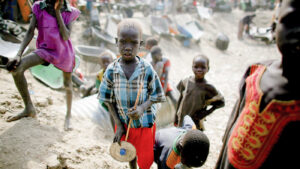
For the third time in 20 years, the UN has declared a full-fledged famine. The proclamation refers to the Zam Zam refugee camp on the outskirts of Sudan’s city of El-Fasher. Médecins Sans Frontières, a charity, reported in April that every two hours, a kid in the camp died of malnutrition or disease—and the situation has only gotten worse since.
But it is not just Zamzam who is facing a terrifying calamity. The camp has been selected out primarily because it is one of the few areas in war-torn Sudan where the UN has accurate information. In fact, starvation has gripped much of the country (see map). It is almost guaranteed to be as catastrophic, if not worse, than the one that devastated Ethiopia during the 1980s. If much more assistance does not arrive soon, the situation may become the worst in the world since millions starved to death during China’s Great Leap Forward in the late 1950s and early 1960s.
The famine is the result of Sudan’s civil war, which began in April 2023 when the army and an auxiliary militia, the Rapid Support Forces (RSF), clashed. The resulting conflict has a strong claim to being the largest and most destructive in the world today. The battle itself has killed an estimated 150,000 people. At least 245 towns and villages have been burned. Much of Khartoum, Sudan’s capital, has been flattened. Over 20% of the country’s pre-war population of over 50 million people has been forced to evacuate their homes. Some have sought sanctuary in adjacent countries, such as Egypt. However, the vast majority of the displaced—nearly 8 million—remain in Sudan, many of them in camps such as Zamzam. According to Médecins Sans Frontières, 80% of health facilities in conflict zones have been destroyed by bullets and bombs. “Our country is being destroyed by the hour,” says Burai Sidig Ali, governor of the central bank, which has already been pillaged and torched.
Initially, violence was primarily confined to Khartoum and Darfur, an area the size of Spain where the RSF has restarted an ethnic cleansing drive against black African ethnic groups that Arab militias began 20 years ago. However, according to Tom Perriello, America’s special envoy to Sudan, the battle has grown into “five or six different wars at the same time”.
The ever-shifting battlefield also impedes the flow of humanitarian aid. According to Eddie Rowes, the World Food Programme’s chief in Sudan, more over 200,000 tonnes of food were given between April 2023 and July 2024, significantly less than what was required. The RSF and other militias have stolen and damaged some of the supplies, contributing to the scarcity. However, the SAF bears much of the burden, as it is unwilling to allow food into regions controlled by the RSF, including the majority of Darfur.
A single convoy of relief vehicles can spend six weeks or more at Port Sudan before being cleared by the SAF for further travel. Even then, practically all of it is directed to SAF-controlled areas. Only a small portion has reached Darfur. On August 15th, the SAF agreed to enable humanitarian groups to restart supplies through a critical border crossing controlled by the RSF between Chad and Darfur. That should assist, but the army is still dragging its feet on the essential documentation. By rejecting peace discussions and obstructing supplies, the two parties are condemning millions of Sudanese to death.
Source: Economist