

There are very few government interventions that promote fairness and social justice and at the same time promote productivity in the economy and in society at large. The investment in disadvantaged children is certainly one. Disadvantaged early environments are powerful predictors of adult failure on a number of social and economic measures. Disadvantage is associated with poor parenting practices and lack of positive cognitive and noncognitive stimulation. A child who falls behind may never catch up. Gary Becker theoretical models predict that for a policy to be conducting the marginal benefits out of it shall be more than the marginal costs of it. Heckman experimental evidence shows that the marginal benefits of education are very high at the preschool period and it starts to decline rapidly as children age.
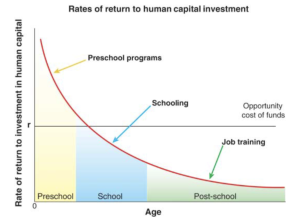
Preschool period is when a little help would go big! Early interventions targeted toward disadvantaged children have much higher returns than later interventions such as reduced pupil-teacher ratios, public job training, convict rehabilitation programs, tuition subsidies, or expenditure on police.
Source: Skill Formation and the Economics of Investing in Disadvantaged Children
James J. Heckman