

There is a large difference between the economic situation among different states of China. While the coastal provinces are well combined to the world economy, the central parts are lagging behind. Today’s inequality actually roots back to the Deng Xiaopeng era, when he started the free economic zones in the 1980s and let private enterprise flourish. “Let some people and some regions get rich first,” said Deng.
Gross domestic product per person in the west and north-east, which make up most of China’s land mass and hold a third of its population, is 70,870 yuan and 60,400 yuan, respectively. Along the coast it is 124,800 yuan. China’s richest provincial-level unit, Beijing, is four times wealthier than its poorest, Gansu!
On the other hand, such extreme disparity is an insult to a nation run by a communist party. The policy known as “Go West” was initiated almost ten years ago to address this problem. China’s interior provinces have been the target of attempts by the national government to redistribute wealth. Large-scale infrastructure projects were at the center of the campaigns. More than all of Japan’s track has been constructed on around 40,000 km of railways in western China since the go-west policy was implemented. Authorities also constructed airports, bridges, and roadways. The Belt and Road Initiative, an ambitious endeavor to reconstruct the historic Silk Road trade route that connected China with Central Asia and Europe, was closely associated with several of these initiatives.
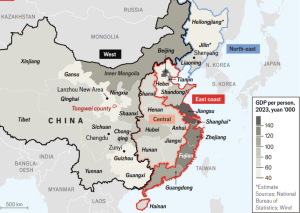
The GDP per capita in the western provinces increased from only 35% of coastal levels to 54% in the 15 years following the implementation of the go-west initiative. It increased to 71% in the northeast from 62%. Nowadays, extreme poverty is uncommon in the hinterlands. Therefore the government plan was successful to some extent. However, regional disparity has either stayed persistent or worsened during the last ten years. Currently, western province dwellers earn almost 57% more than coastal people. Earnings in the Northeast are 48% higher.
Source: Economist