

Voluntary carbon credit markets are another way to fight global warming. Instead of lowering your carbon emissions you could pay someone else to reduce its carbon emission or to offset your carbon productions. Unlike the compliance markets that are regulated by the governments and the public sector sells the carbon allowances in the market, in the voluntary carbon credit market, both sides are private sector, the issuers of carbon credit noted are companies which invest in green projects including forestry, hydroelectric dams, solar and wind farms and greener house appliances. The notes are for reducing one tonne of Carbon Dioxide (or equivalent greenhouse gasses). The buyers are all the companies that would like to decrease their carbon footprint namely, oil and gas companies, Iron and Steel and Aluminum Companies, petrochemicals and airliners.
This voluntary carbon market was praised by the governments in 2021 after the Glasgow climate summit, but since then the prices are falling and buyers are moving away from it. A recent report by the Guardian further diminished the prices. The nature-based carbon offsets are down from $15 to 0.1 after Dubai climate submit.
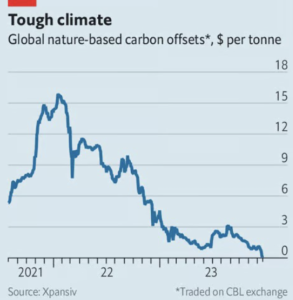
According to a Guardian report most of the 50 top projects that are the sources of carbon offset notes, either lack transparency, or are likely to be conducted even if the notes were not issued in the first place, or offset much lower carbon than what they claim. According to Guardian 39 items out of these 50 projects are considered to be junk, 8 are potentially junk and 3 remaining lack transparency and the necessary information.
Of course, a voluntary carbon market can be efficient and beneficial. According to MacKinsey, a consultancy firm estimates that by 2030, the voluntary carbon credit can reach to $ 50 billion from today’s $ 2 billion. The low prices might pour in corporate buyers. But the obvious thing is that there is a large information asymmetry between the buyers and the sellers. The sellers can issue notes that do not genuinely contribute to the greenhouse reduction or offsetting. A third parity middleman is needed to check and verify the projects.
Source: Guardian and Economist