

After gross domestic product (GDP), the human development index (HDI) is one of the most widely used indicators. Unlike GDP that is only an economic production indicator, the HDI encapsulates social indicators such as life expectancy and expected years of schooling. The United Nations publish the data on an annual basis. Of course, the HDI index does not cover many other issues; one example is inequality between ethnicities and genders. But it is more inclusive than gross domestic product.
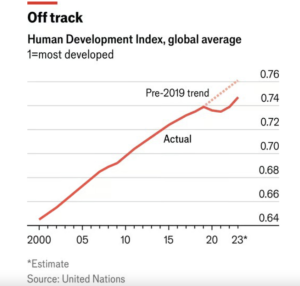
According to 2023 published data, Switzerland is at top for the second consecutive year. Other countries in Western Europe are also on the top of the list. Some countries in Eastern Asia are also doing great, the top examples are Singapore and Hong Kong. On the other side of the spectrum, there are countries that made little progress. HDI indexes in Peru, Colombia, Libya and Lebanon have made little progress since the pre-Covid levels. COuntries like war-torn Yemen, poor and indebted Belize, and Micronesian an island country at the risk of being swallowed by the sea level, all had their peak at 2010 and are degrading since then.
The average global HDI index permanently rose from 1990, the year it was established by the UN. but in 2020 and 2021, it fell due to the Crona shock. It has been recovering since then but as you can see, we are still suffering a loss from the Covid, the trend is almost resuming at the same speed, but we are following the path on a lower level.
According to the HDI index the gap between the poor and rich countries is rising from 2020. Most rich countries are at their pre-Covid levels or surpassed it. But it is not the case for less developed countries. This gap has been narrowing for the last twenty years with the exception of the 2008 financial crisis, but it is showing divergence again.
Source: Economist