

The growth rate in developed countries has been trending lower over past decades. Economists have warned about it for a long time. Without meaningful growth, nations would end up with no progress and expansion income and expenditures. That is not an ideal world. Recently the uprising of the AI has ignited new hopes that growth rate would boost in the coming decades. However, the extent to which it is helpful or not is still somewhat of a question mark.
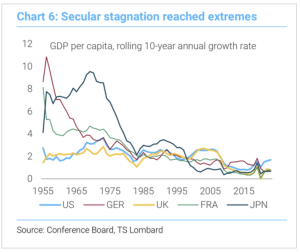
The main reasons for this diminishing growth is saturation of capital and decrease in technical advancements. Back in 1950 and 1960, capital was still scarce, even in the developed countries, and because of this, an increase in the capital, through investment, would have boosted production. Thus a rise in savings has a meaningful contribution to growth in those decades. But nowadays, the capital has become so abundant that the marginal rate of production for new units of capital has diminished sharply. In other words, new capital is not much needed and much helpful! The other factor is technological advancements, which is called Total Factor Productivity (TFP) by economists. It includes all other factors aside from capital and labor which are intangible but have a meaningful effect on the production. Many economists hope that AI can indeed boost the TFP of all countries and especially that of more developed countries. However, we shall wait more to see if that is truly affecting Total factor productivity.
Source: TS Lombard