

Development goes beyond financial gain. It takes into account a variety of factors, including security, income, and relationships across societies. Lack of income is not the only issue facing many impoverished African countries; security is another drawback. Niger is a fascinating case study. This nation, which is among the poorest in Africa, is situated on the edge of the Sahara desert. In 2020, its Human Capital Index ranking was the lowest.
Beginning in 2012, the government launched a cash transfer program that gives qualifying households monthly payments of CFAF 10,000 (US$15.98, $38.98 PPP) for a period of two years.The World Bank is funding this program, which has gained significant attention because it is run by the prime minister’s office’s safety nets unit. Between 2012 and 2019, it served almost 100,000 beneficiary households, and it has since grown even more. The unconditional financial transfers are given in conjunction with activities that support positive parenting and child development, as well as supplemental interventions that help diversify sources of income. Public lotteries were used to randomly choose the villages, and then poverty targeting was used to identify the benefit households.
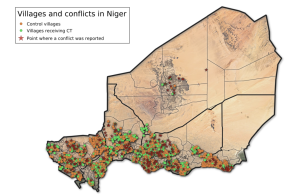
In this map you can see the villages who received these cash transfers with green dots. The control communities (who did not receive cash transfers) are plotted with brown dots.
There is ample proof that the initiative has been effective. It was discovered that cash transfers increased economic activity and asset accumulation while also increasing consumption by 10% on average. There are, nevertheless, unexpected side effects. There were more serious clashes and looting incidents. The red stars on the map indicate the locations of significant looting and violence. In comparison to brown dots, the red stars are statistically closer to green dots. Distributing financial transfers is therefore equivalent to raising the possibility of serious clashes, looting, or Boko-Haram terrorist strikes. The statistics showed that monetary transfers raised the likelihood of a serious conflict in a community by 1.1 percentage points, from 0.6 to 1.7.
Is it worthwhile, though? Most likely, it is! The benefits of this cash transfer program surpass the cost of an increased risk of disputes if the social benefit of the program is greater than 1.1 percent of the social cost of conflicts.
Source: Cash and Conflict, Large-Scale Experimental Evidence from Niger
World bank, Policy Research Working Paper